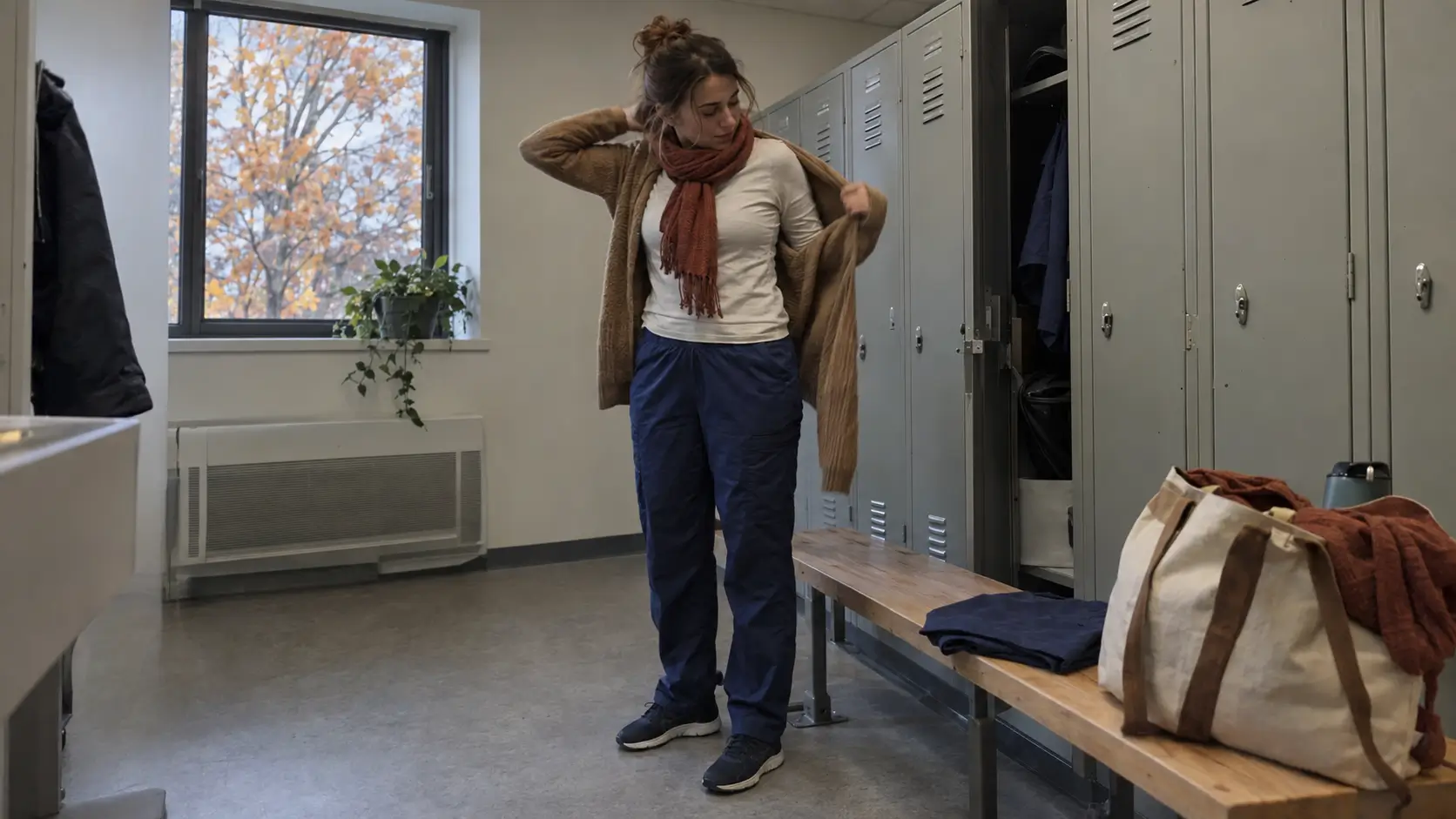
The change happens twice a day for most nurses: once before the badge goes on, once after it comes off. Fall adds a wrinkle neither summer nor deep winter has — a 6 a.m. parking lot that’s 40 degrees and a 7 p.m. one that’s suddenly 55, sometimes on the same shift.
None of this calls for a whole new closet. It calls for pieces that go on fast over a scrub top, come off just as fast in a car with the engine still running, and don’t need a mirror to get right.
These 19 ideas are grouped by when the change actually happens — the drive in, the drive home, the errand stop in between, and the bag that has to cover whatever the shift throws at it.
The Drive-In: What Goes Over the Scrub Top
These four are worn over the scrub top for the walk from the car to the building, then shed at the locker — except for the base layer, which stays on underneath for whatever the unit’s thermostat is doing.
1. Ribbed Thermal Under a Wool Peacoat
A ribbed thermal top goes on first, tucked in where the scrub top will cover it, then a wool peacoat goes over the whole thing for the walk in from the parking structure.
The peacoat comes off the second the locker door opens; the thermal stays under the scrub top for a unit that runs cold enough to need a base layer by 10 a.m.
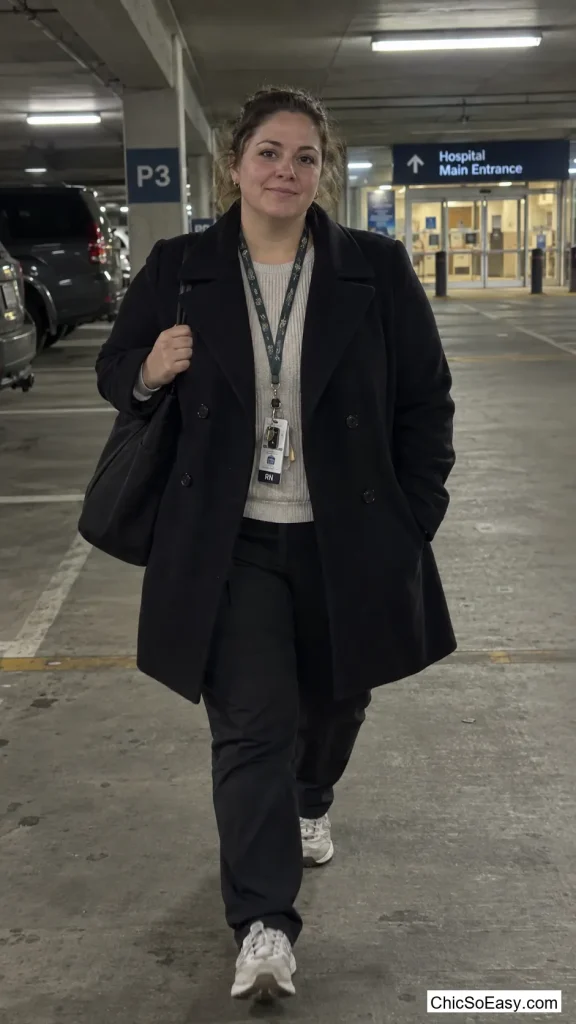
2. Fleece-Lined Henley Under a Barn Coat
A fleece-lined henley goes on under the scrub top, buttoned to the collar so it doesn’t show above the neckline, with a canvas barn coat over the whole thing for the actual walk to the door.
The barn coat’s boxy cut leaves room for a badge and lanyard to hang without catching on anything, and the corduroy collar doesn’t scratch on a cold morning the way some wool ones do.
If the coat gets left in the car by accident on a rushed morning, the henley alone is warm enough for the sprint from the lot to the entrance.
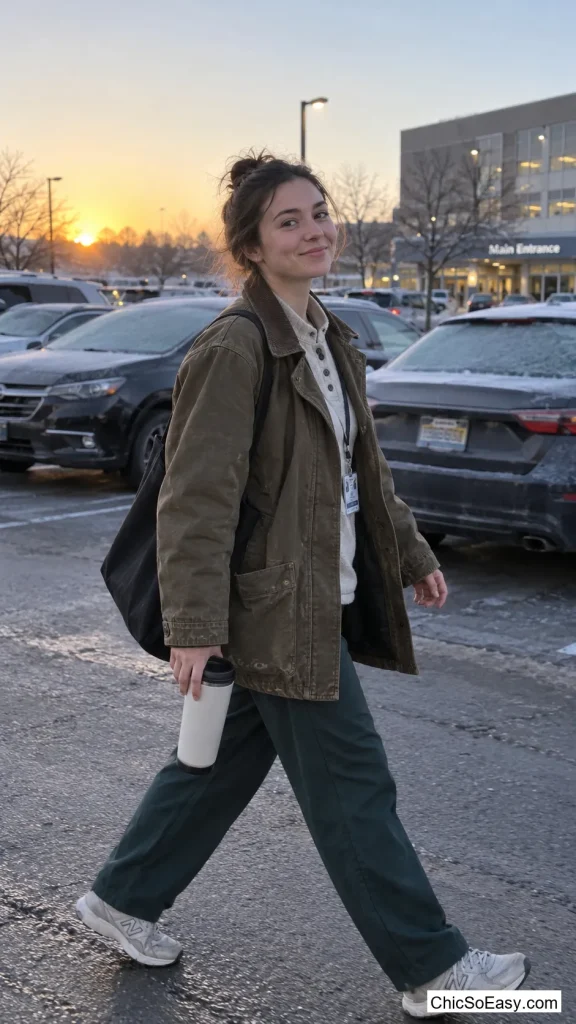
3. Waffle Tee Under a Quilted Vest
A waffle-knit long-sleeve tee sits under the scrub top, with a quilted vest zipped over both for the drive and the walk in.
The vest leaves the arms free, which matters for anyone carrying a lunch bag, a water jug, and a coffee in the same trip from the car.
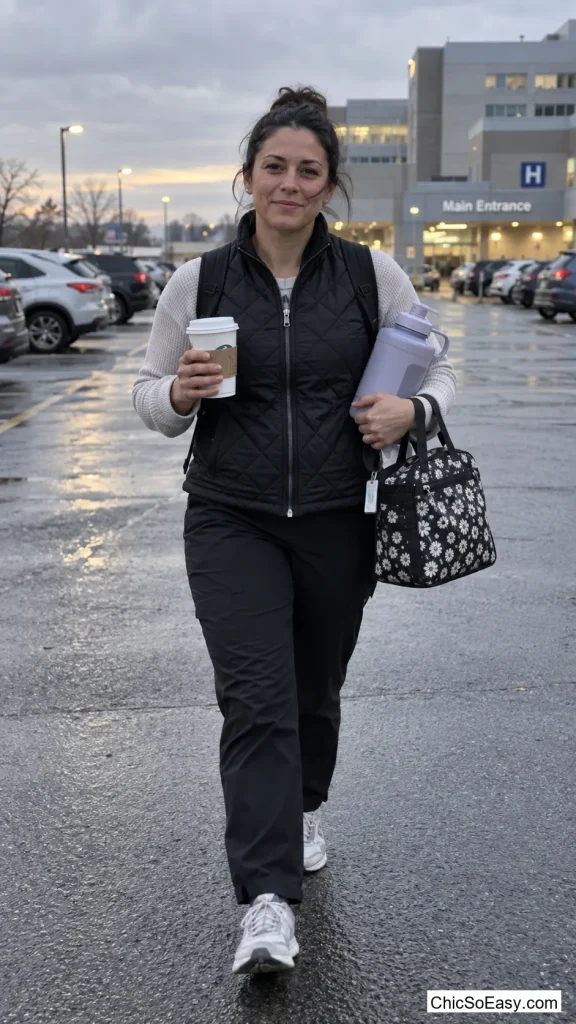
4. Mock-Neck Layer Under a Chore Coat
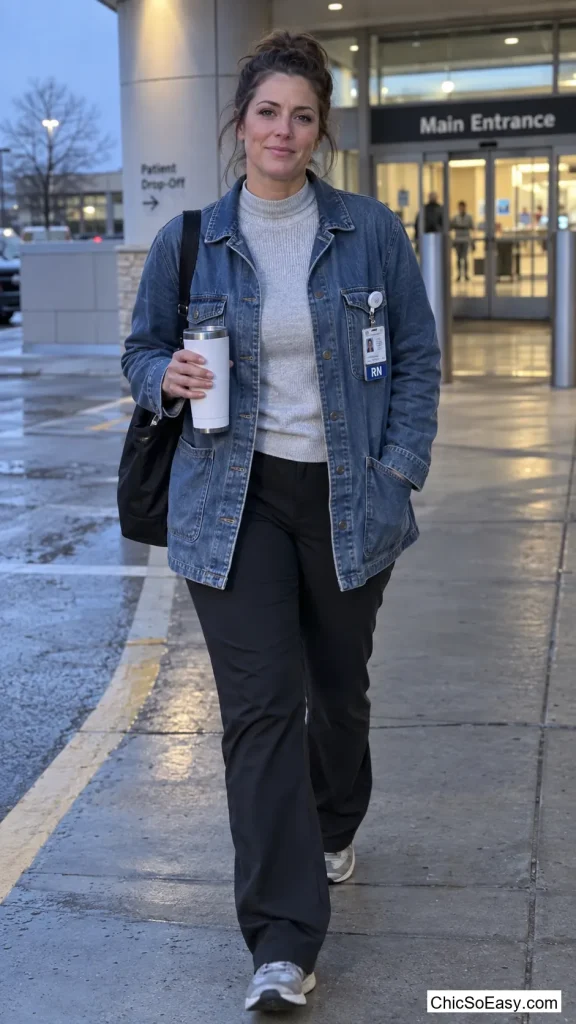
A mock-neck thermal layer goes on first, high enough to cover the throat on the walk in, with a denim chore coat over the scrub top for the drive.
The chore coat’s straight, unlined cut doesn’t add bulk under a seatbelt, and its two chest pockets hold a phone and a badge reel on the walk from the car so nothing rattles around in a bag.
On the coldest mornings, the mock-neck stays under the scrub top for the first hour of rounds, then gets pushed down under the collar once the building warms up.
The Peel-Off: The First Thing After the Badge Comes Off
This is the outfit waiting in the car or the bag for the second the scrubs come off — no zippers that fight swollen fingers, no waistband that needs sitting down to fasten.
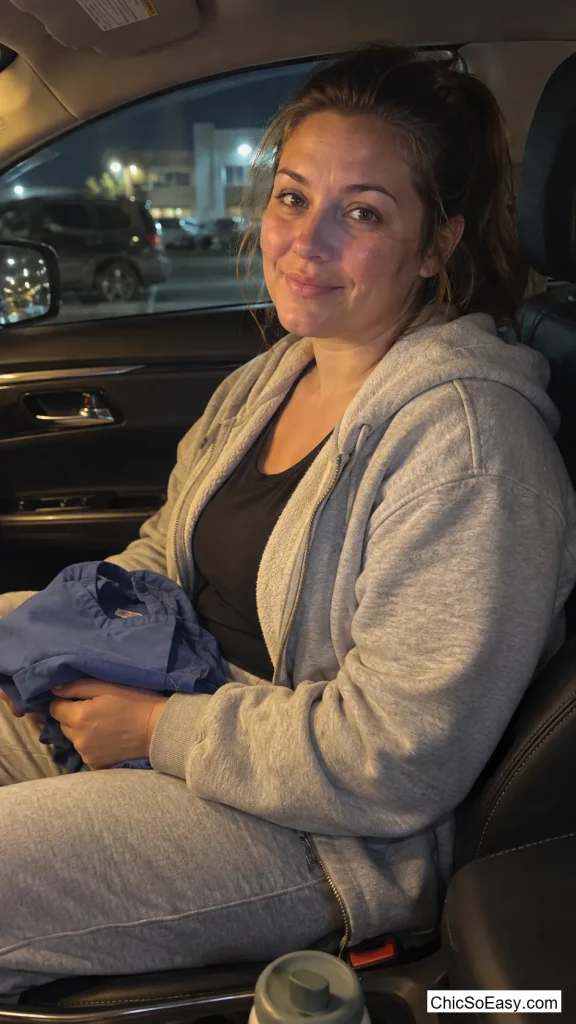
5. Zip-Front Hoodie and Wide-Leg Sweats
A zip-front hoodie and a wide-leg sweatpant, both a size up from normal, waiting on the passenger seat for the moment the scrub top comes off in the car.
The zip front means it goes on without pulling anything over the head, which matters after twelve hours in a ponytail that’s been through a shift, and the wide leg clears the ankle without needing to sit down to adjust it.
6. Quilted Vest Over a Ribbed Tank
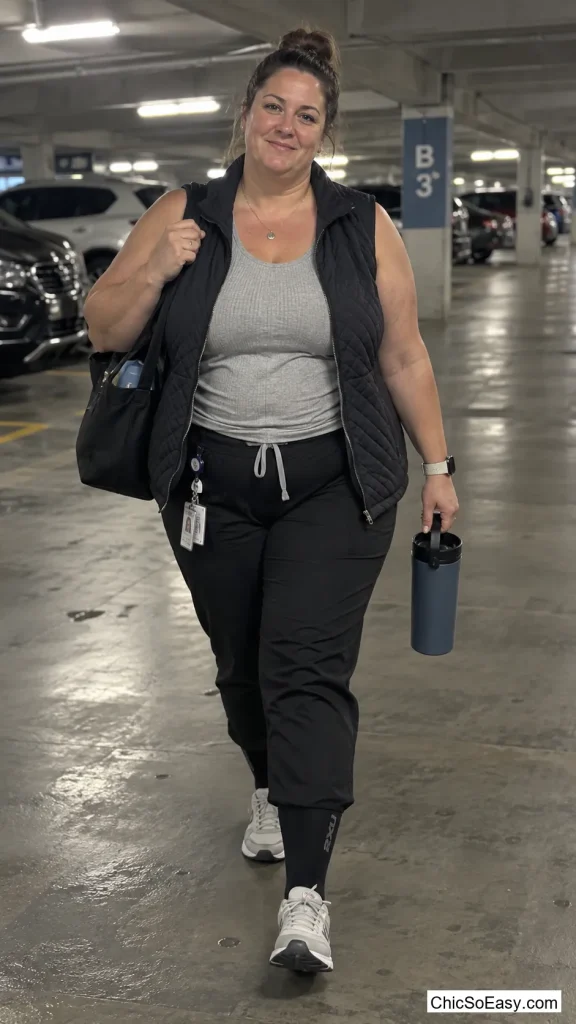
A ribbed tank top and a quilted vest, worn over leggings that stayed in the bag all shift for exactly this moment.
The tank has no sleeves to fight over compression socks that haven’t come off yet, and the vest adds enough warmth for the walk to the car without needing sleeves at all.
7. Oversized Flannel Over Bike Shorts
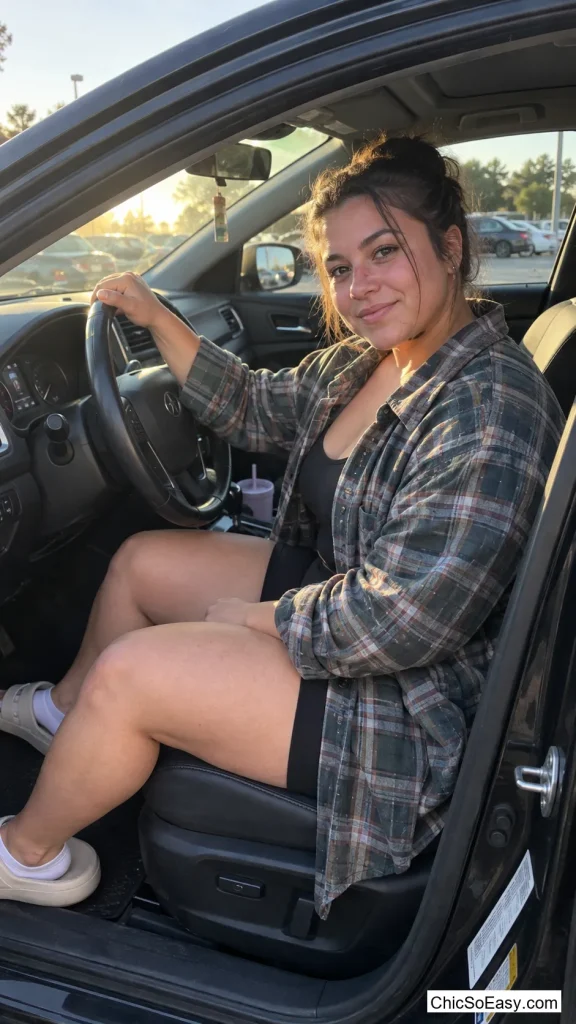
An oversized flannel shirt, worn open over bike shorts and slides, for the change that happens directly in the driver’s seat before the car even starts moving.
The flannel’s length covers enough that the bike shorts read as loungewear rather than workout gear, and the button front opens and closes one-handed while the other hand is still holding a badge reel.
Slides go on faster than anything with laces or a strap, which matters when feet have been in compression socks and closed shoes for twelve straight hours.
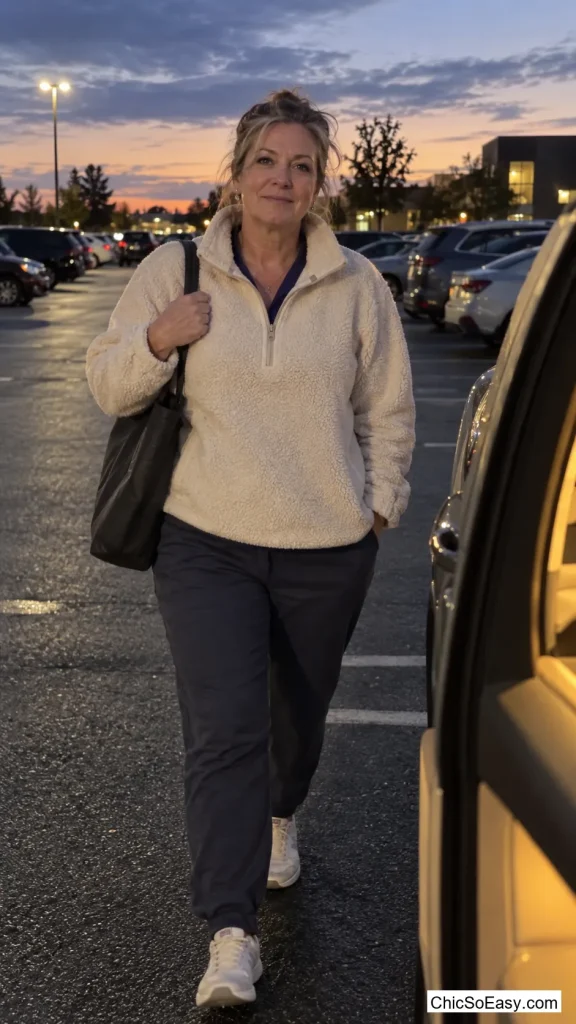
8. Sherpa Half-Zip and Straight-Leg Joggers
A sherpa-lined half-zip pullover over straight-leg joggers, both left folded on top of the bag specifically for the drive home.
The half-zip vents at the collar if the car heater is already running, and the straight leg doesn’t bunch up under a seatbelt the way a tighter cuff does.
The Errand Stop Between Shift and Home
For the days a shift ends and there’s still a pharmacy pickup or a grocery run standing between the hospital and the couch, these hold up under fluorescent lights without looking like they were thrown on in a parking garage.
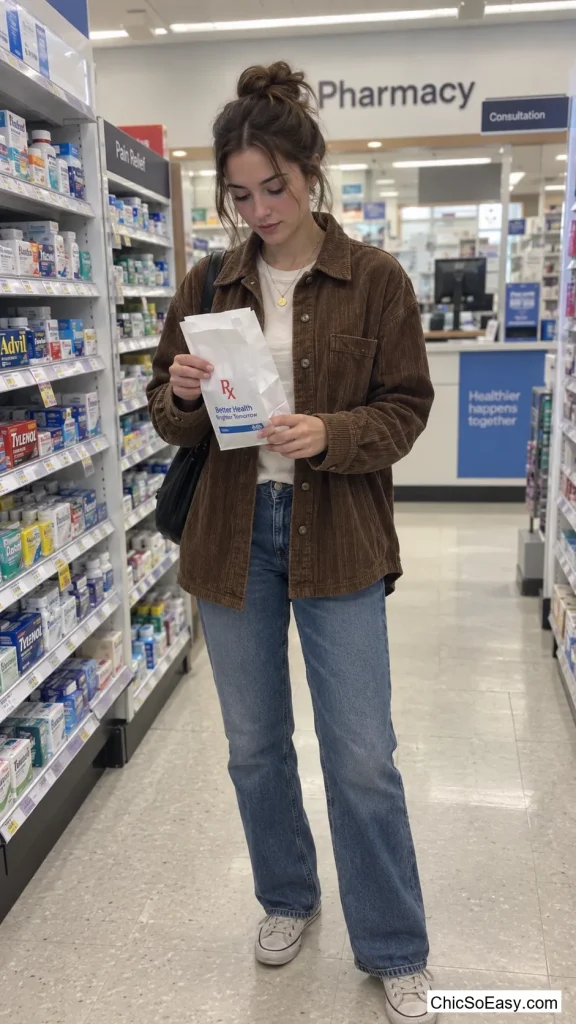
9. Corduroy Overshirt and Straight-Leg Jeans
A corduroy overshirt buttoned over a plain tee, with straight-leg jeans and sneakers, for a pharmacy stop that comes right after clocking out.
The corduroy’s texture does more visual work than a plain shirt would, so the outfit reads as put-together under store lighting without needing anything ironed or tucked.
10. Knit Polo and Wide-Wale Cords
A ribbed knit polo tucked into wide-wale corduroy pants, with loafers that slide on without bending down.
The polo’s collar keeps the look from reading as pajamas the way a plain tee might, and the wide-wale cords have enough give in the waistband to stay comfortable after a shift spent standing.
A cropped denim jacket goes over the top if the store or the parking lot turns out colder than the car was.

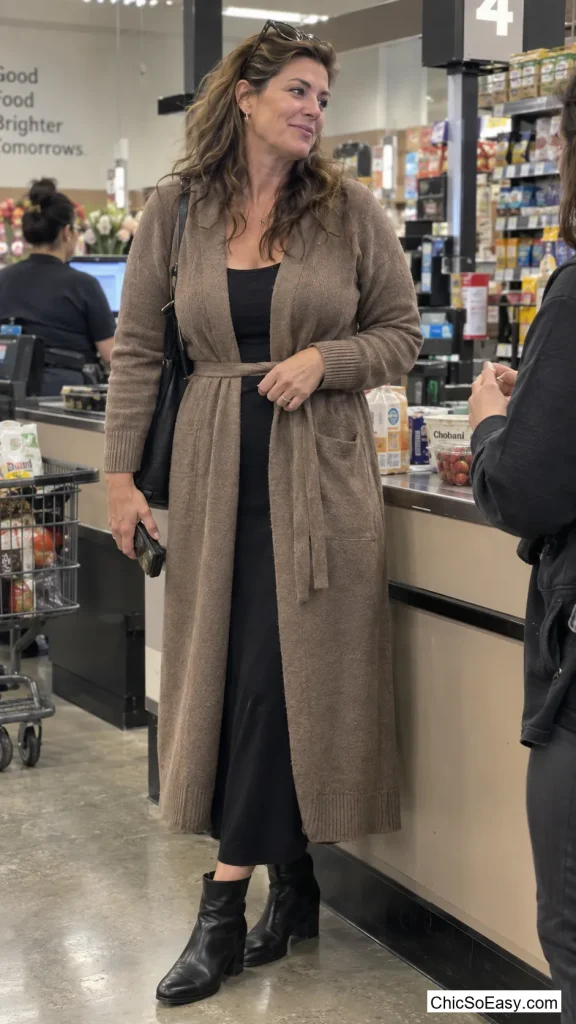
11. Belted Cardigan Over a Column Dress
A long, belted cardigan over a simple column dress and ankle boots, for the days a grocery run turns into running into a coworker from another floor.
The dress alone is nearly shapeless, but the belt at the cardigan’s waist gives the whole thing a defined middle without a single fitted seam anywhere on the body.
Built for the Dark Half of the Drive
Night shift means driving to work at dusk and home after sunrise, both stretches with drivers who are half-asleep. These lean toward visibility and warmth over anything else.
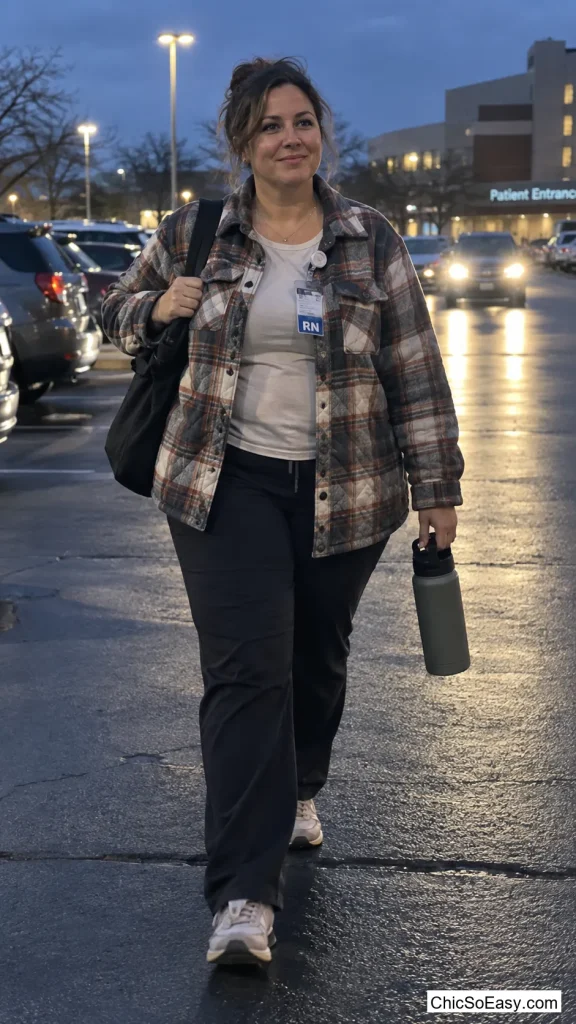
12. Quilted Flannel Shacket for the Drive
A quilted flannel shacket, heavier than a regular flannel and lined enough to skip a coat underneath, worn over a plain tee for the dusk drive to a night shift.
The lining means one layer does the job two would otherwise need, which matters on a night that starts at 7 p.m. and won’t see daylight again until the drive home.
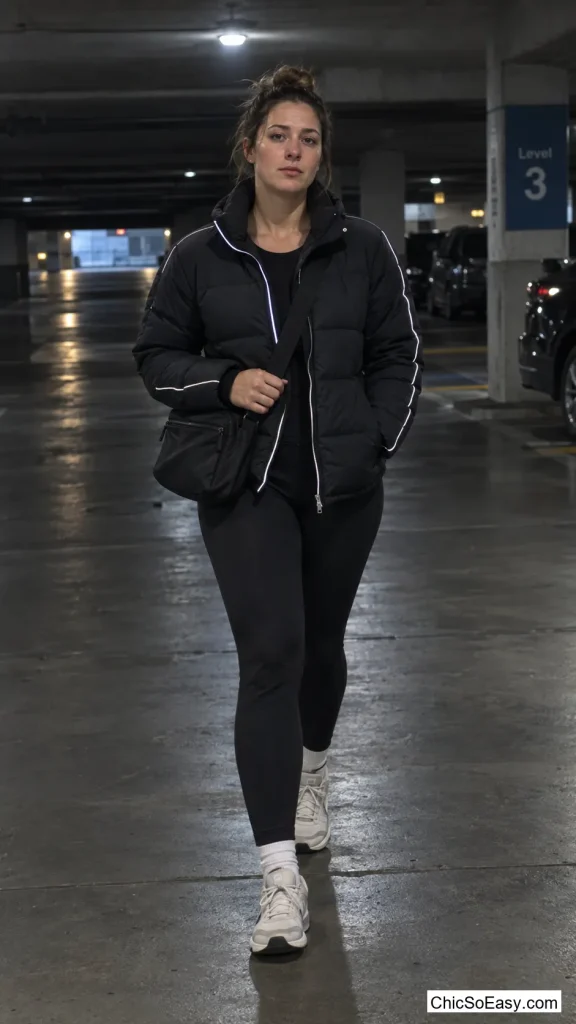
13. Reflective-Trim Puffer and Fleece Leggings
A puffer jacket with reflective piping along the zipper and cuffs, worn over fleece-lined leggings for the walk across a hospital parking garage that’s dark at both ends of a night shift.
The reflective trim isn’t decorative here — it’s the difference between being visible and invisible to a car pulling out of a garage exit at 6 a.m., and the fleece lining holds heat better than a plain legging in the hour before sunrise.
A crossbody bag instead of a shoulder tote keeps both hands free for a coffee and a set of keys on the walk to the car.
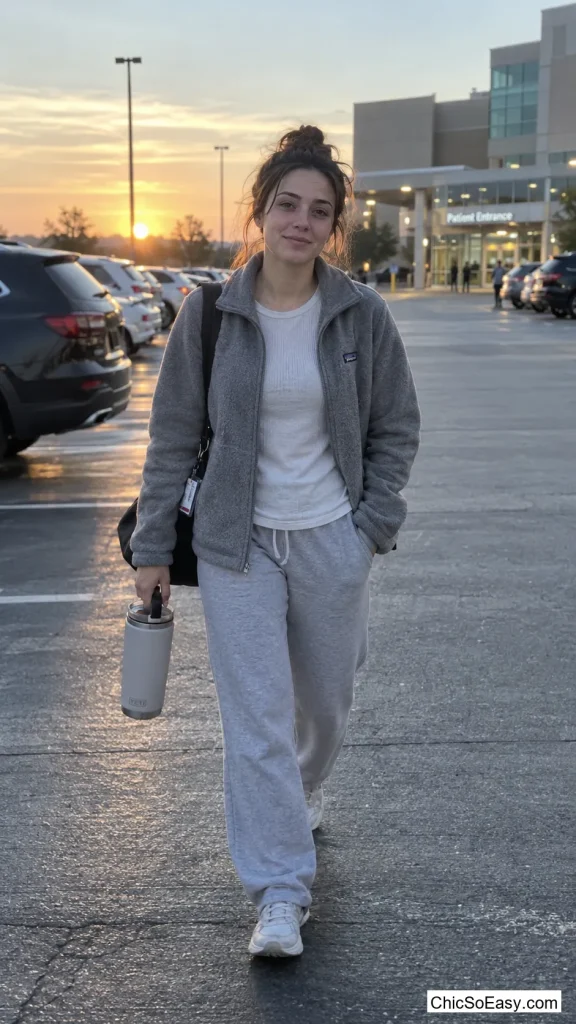
14. Ribbed Thermal Top Under Straight Sweats
A ribbed thermal top under a zip-up fleece, paired with straight-leg sweatpants, for the drive home after a night shift when the sun is coming up and the car hasn’t been sitting in the cold overnight.
The straight leg is loose enough to pull on over shoes still on the feet, which saves a step when the goal is getting horizontal as fast as possible.
Layers That Live in the Work Bag
A 12-hour shift can start at 45 degrees and end at 65, or the other way around. These fold small enough to sit at the bottom of a work bag until the temperature actually changes.
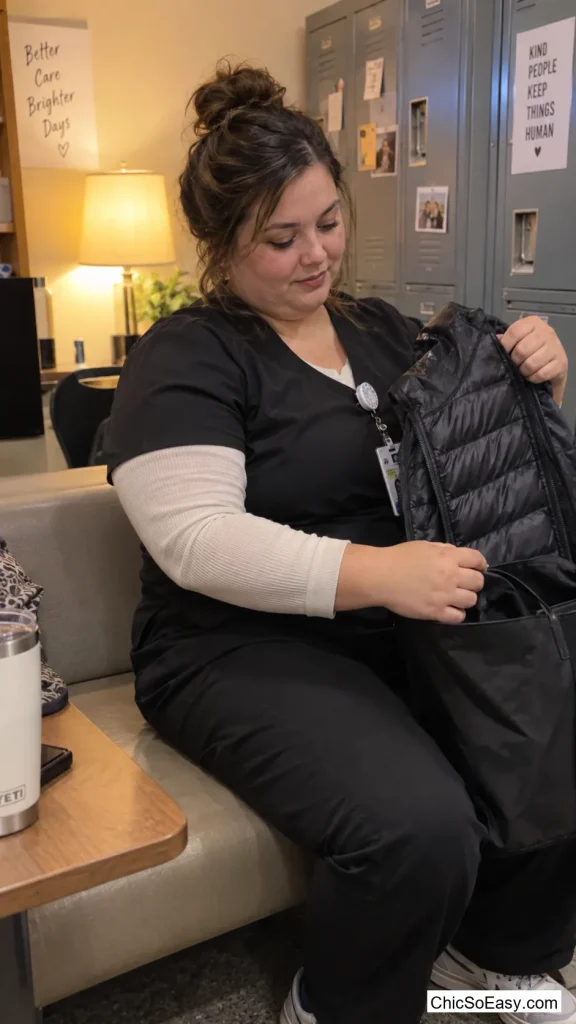
15. Packable Puffer Vest and a Thermal Tee
A thin thermal long-sleeve and a packable puffer vest that compresses down to the size of a water bottle, kept at the bottom of a work bag for whichever direction the temperature moves.
Both pieces are thin enough to layer under a scrub top if the unit runs cold, or over it alone if the walk to the car is the only cold part of the day.
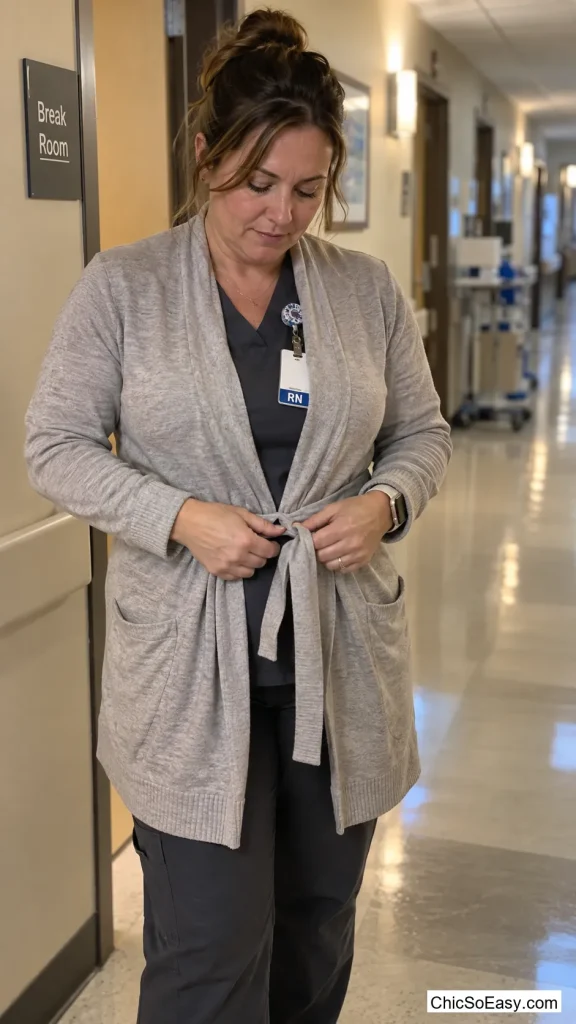
16. Wrap Cardigan That Folds Flat
A lightweight wrap cardigan with no buttons or zippers to catch on anything, folded flat in a bag pocket for a shift that might end ten degrees cooler than it started.
The wrap front adjusts by tying rather than sizing, so it works over scrubs, over the after-shift outfit, or over whatever got thrown on for an errand — one piece covering three different moments in the same day.
It wrinkles less than most cardigans when balled up in a bag all shift, which is most of the reason it earns a permanent spot there.
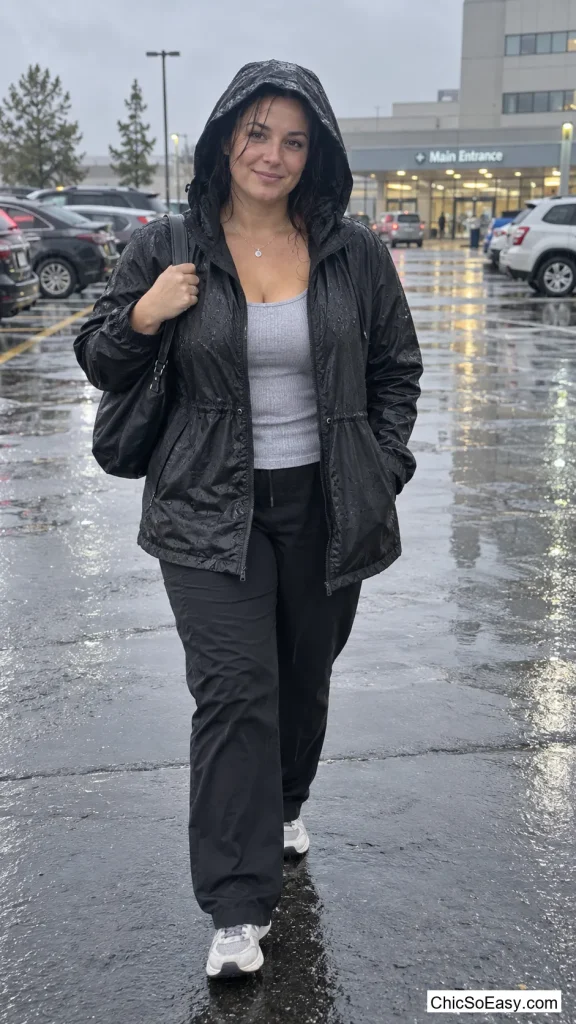
17. Ribbed Cami Under a Packable Anorak
A ribbed cami as a base layer and a packable anorak with a hood, both thin enough to stuff into a side pocket without taking up locker space.
The anorak’s hood covers for a shift that ends in rain instead of just cold, which fall does often enough that a hood earns its place over a plain jacket without one.
Fall Days Off That Actually Feel Like It
For the two days off between stretches, when the point is to not look like someone who just worked one.
18. Cable Knit Sweater and Straight Denim
A cream cable knit sweater over straight-leg denim and ankle boots, for a day off that has nothing to do with a hospital.
The chunky knit does the opposite job of everything worn on shift — it’s meant to look bulky and feel slow, the exact texture that doesn’t exist anywhere in a scrub closet.

19. Flannel-Lined Trucker Jacket and Leggings
A flannel-lined trucker jacket over a plain long-sleeve and leggings, for a pumpkin patch or a football afternoon on the first real day off in a five-shift stretch.
The trucker’s boxy fit and flannel lining make it warmer than the denim alone would suggest, and it layers over a hoodie underneath without looking like two jackets stacked on top of each other.
Duck boots instead of sneakers handle actual mud, which matters more at an orchard or a patch than it ever does in a hospital hallway.

Final Thoughts
None of these outfits need to survive more than the length of a drive or an errand. The ones worth keeping in rotation are the ones that go on fast, layer over what’s already being worn, and don’t ask for a second thought on a morning that’s already moving too fast for one.